- Magazine
- Healthcare
- MedTech’s invisible enemy: The growing challenge of electromagnetic interference
MedTech’s invisible enemy: The growing challenge of electromagnetic interference
Electromagnetic interference is a critical and increasingly complex threat in modern healthcare environments, driving demand for next-generation shielding solutions that ensure reliable electronic performance while retaining good properties.
Healthcare
21.01.2026
Electromagnetic interference (EMI), which refers to the disturbance of a device’s performance by an unwanted electromagnetic field, is a serious concern in healthcare environments, risking distorted signals, data loss, and dangerous malfunctions if devices are not designed according to electromagnetic compatibility principles.
Healthcare’s escalating EMI landscape
In a busy hospital environment where imaging systems, diagnostic tools, monitoring equipment, and infusion pumps operate in close proximity, interference risks are abundant. Some medical devices can be particularly powerful sources of EMI such as electrosurgical tools and magnetic resonance imaging (MRI) machines, while wireless communication systems such as WiFi, Bluetooth, and mobile phones add to the crowded signals.
EMI risks are increasing in healthcare settings as the number of electronic devices with wireless data transfer proliferates, creating an increasingly complex environment of signal sources. Previously static and bulky devices are becoming more and more portable, meaning the location of EMI sources is shifting and hard to predict. Modern ultrasound machines are now handheld, for instance, wirelessly transmitting images to tablets or smartphones for point-of-care diagnostics.
Outside of traditional healthcare settings, EMI is still a challenge for medical devices. For example, wearables must remain accurate during daily use so that patients can depend on them for important health tracking requirements, from glucose monitoring to arrythmia detection. Yet certain environments with high concentrations of overlapping electromagnetic fields, including urban areas, gyms, and industrial zones, can cause problems for sensitive electronics.
With wearables, the challenge is heightened by the dense, tightly packed nature of these miniaturised devices and their low operating powers, making them more susceptible to external EMI as well as self-interference, with sensitive components placed close to internal interference sources.
The danger of EMI
In healthcare settings, the sources of electromagnetic interference are not only abundant – their effects can be particularly dangerous. Imagine a complex robotic surgical system reliant on precise sensor signals and continuous data communication for control. Even a minor sensor misreading caused by electromagnetic interference could trigger an alignment error, with potentially critical patient safety impacts.
In worse case scenarios, EMI can cause complete malfunctions of lifesaving medical devices such as ventilators and cardiac monitors. EMI can also wreak havoc with imaging systems, introducing distortion into the data. This distortion manifests as screen flickering, colour alterations, and static, affecting the clinician’s ability to detect subtle abnormalities and possibly leading to missed or incorrect diagnoses.
These examples underscore the critical importance of electromagnetic compatibility (EMC) in device design. EMC refers to a device’s ability to function properly in its intended electromagnetic environment, ensuring medical devices are protected from external interference while also limiting the disruptive signals they generate themselves. For medical device companies, EMC is both a functional requirement and a fundamental regulatory standard. As part of EMC, shielding is pivotal.
EMI shielding in medical devices
Shielding from EMI involves using conductive materials to block electromagnetic fields, creating a conductive barrier to protect signal integrity and the reliable performance of the device. Shielding can be applied around individual components or around the entire PCB. At the device level, it can be used to seal gaps between materials (e.g. gaskets, O-rings) or even enclose the entire device. Cables and connectors may also be shielded and possibly connected to the ground to prevent cables from acting as an antenna.
For particularly sensitive devices or those producing extremely powerful signals themselves, such as MRI machines, it can be necessary to line the entire room with shielding materials, blocking unwanted signals and containing magnetic fringe fields.
Common materials used in shielding applications include metals such as aluminium, copper, nickel and silver. Silicone elastomers are another option and a popular choice for gaskets, providing flexibility, durability, and great resistance to temperatures, chemicals, solvents, and sterilization procedures. Silicones are also ideal for wearables and other miniaturised devices, offering compatibility with liquid injection molding for intricate designs and efficient production.
In 2025, Elkem introduced a next-generation electroconductive liquid silicone rubber material called Silbione™ LSR EC 70 for the medical device market, addressing traditional problems faced with electroconductive materials through the incorporation of carbon nanotubes. Intended for wearable and diagnostic devices, the new silicone elastomer combines robust electrical conductivity with certified biocompatibility and enhanced process control, setting a new standard for medical device manufacturers targeting precision healthcare applications.
To learn more about the growing demand for electroconductive silicones in medical devices and their evolution, please download the whitepaper below.
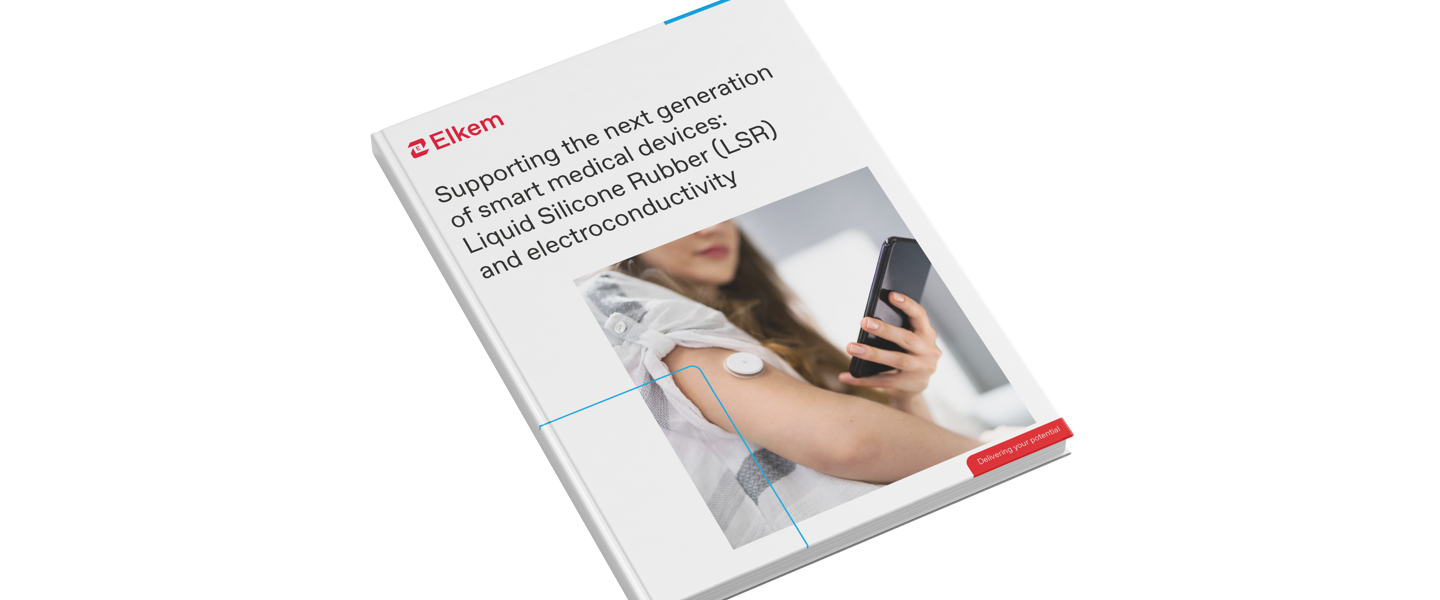
Supporting the next generation of smart medical devices: Liquid Silicone Rubber (LSR) and electroconductivity
This whitepaper explores some of the biggest trends in MedTech today, from the use of robotics in surgery to wearables in everyday life, and how these trends are fueling the need for liquid silicone rubber (LSR) and electroconductive materials.